Tú vs Usted: How to Use Each, Differences & Examples

Tú vs. Usted
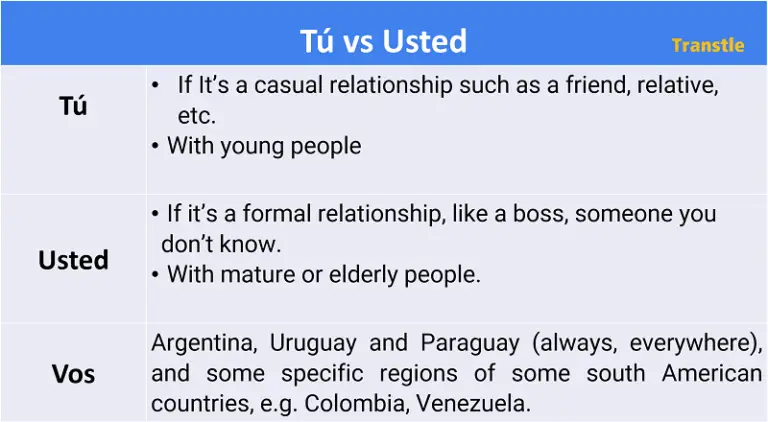
In Spanish, choosing between Tú and Usted is a crucial step for polite communication. While both translate to "you," your choice depends on the relationship, age, and social context. This choice doesn't just change a word—it changes how you conjugate every verb in the sentence.
1. When to use Tú Informal
Use Tú in situations where familiarity and closeness are appropriate:
- Friends and Family: Siblings, cousins, and close friends.
- Children: Generally anyone younger than you.
- Pets: You always address animals with tú.
2. When to use Usted Formal
Use Usted to show deference, distance, or professional respect:
- Authority Figures: Bosses, teachers, doctors, or police officers.
- Unfamiliar People: Someone you are meeting for the first time.
- Older Adults: To show respect to elders outside your family.
Conjugation: How Tú, Usted, and Vos Affect Verbs
The choice of “you” pronoun directly dictates the form of the verb you must use. This is where most of the grammatical impact lies. For more patterns, see our guide on Spanish conjugation:
• Tú Conjugation: Verbs conjugated with Tú typically follow the second person singular conjugation rules. In the present indicative, this often involves an -s ending for regular verbs.
• Usted Conjugation: Verbs conjugated with Usted follow the third person singular conjugation rules, just like él (he) or ella (she). In the present indicative, regular verbs generally do not end in -s.
• Vos Conjugation: Verbs conjugated with Vos have their own distinct conjugation patterns. These vary slightly by region, but in generalized voseo (e.g., Argentina), present tense regular verbs often involve a stressed vowel and slightly different endings.
Comparison Table
| Pronoun | Verb: Hablar (Speak) | Verb: Comer (Eat) | Grammar Rule |
|---|---|---|---|
| Tú | hablas | comes | 2nd person (-s) |
| Usted | habla | come | 3rd person (like él/ella) |
| Vos | hablás | comés | Stressed vowel |
Regional Variation: Voseo
In countries like Argentina, Uruguay, and Paraguay, the pronoun Vos replaces Tú entirely for informal speech. In parts of Colombia, Venezuela, and Central America, both might coexist. The conjugation for voseo is distinct from the standard informal form.
Exercises for quick Practice: Tú vs. Usted
Test your knowledge! Select the correct option for each scenario and conjugation.
1. How would you address your new boss in a formal meeting?
Show Answer
2. Which pronoun is best for talking to your best friend?
Show Answer
3. If you are in Argentina and talking to a peer, which informal pronoun is most common?
Show Answer
4. Señor García, ¿Usted ________ español?
Show Answer
5. Tú ________ mucho chocolate.
Show Answer
6. Vos ________ bien el español.