
Tu and Vous in French: Uses, Differences & Examples
Learning French isn’t just about vocabulary and grammar; it’s also about understanding the subtle cultural nuances that make conversations flow naturally. One of the first and most important distinctions you’ll encounter is how to say “you.” Unlike English, French offers two distinct ways: “tu” and “vous”. Mastering their appropriate usage is fundamental to politeness and respect in French-speaking communities.
Using the wrong pronoun can unintentionally convey disrespect or awkwardness, so let’s delve deep into when and how to choose between “tu” and “vous”.
See also: French Subject Pronouns
Understanding “Tu” and “Vous”: The Core Distinctions
The choice between “tu” and “vous” is primarily driven by the level of formality in a situation and the nature of your relationship with the person or people you are addressing.
“Tu”: The Informal “You” (Le Tutoiment)
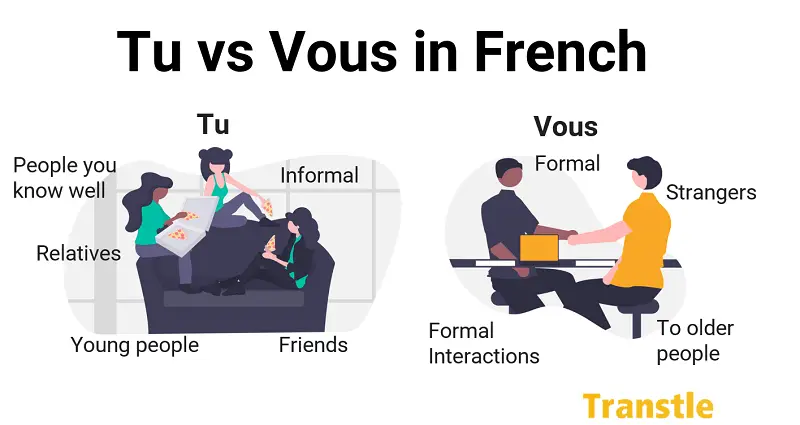
“Tu” is the singular, informal “you.” It’s used in contexts where there is familiarity, closeness, or equality in status. The act of using “tu” is called le tutoiment.
You should use “tu” when speaking to:
- Family members: Parents, siblings, children, aunts, uncles, cousins, grandparents.
- Close friends: People you spend a lot of time with and share personal details with.
- Children: Any child, regardless of whether you know them well.
- Pets: Since animals are typically seen as part of the informal sphere.
- People your own age or younger: Especially in casual, non-professional social settings like parties, youth groups, or university environments. This is becoming increasingly common among younger generations.
Example Scenarios for Tu:
- Talking to your younger sibling about homework.
- Chatting with a long-time friend over coffee.
- Asking a child if they want ice cream.
- Giving commands to your dog.
“Vous”: The Formal and Plural “You” (Le Vouvoiement)
“Vous” serves a dual purpose: it is the singular, formal “you,” and it is also the only way to say “you” when addressing more than one person, regardless of formality. The act of using “vous” is called le vouvoiement.
You should use “vous” when speaking to:
- Strangers: Anyone you don’t know personally, such as someone you meet on the street, a shop assistant, or a new acquaintance.
- People in positions of authority: Your boss, a teacher, a professor, a police officer, a doctor, a government official.
- Older people: As a sign of respect, even if you interact with them regularly (e.g., a neighbor you don’t know very well).
- In professional or business contexts: With colleagues you don’t have a close personal relationship with, clients, or business partners.
- When addressing a group of people: Even if you would use “tu” with each individual in the group, you must use “vous” when speaking to them collectively. This is the plural “you.”
Example Scenarios for Vous:
- Asking for directions from a passerby.
- Speaking to your professor during office hours.
- Addressing the entire class or a team at work.
- Speaking to a cashier in a supermarket.
The Golden Rule: When in Doubt, Use “Vous”
If you are ever unsure whether to use “tu” or “vous”, always default to “vous”. It is much safer to be overly polite than to be perceived as disrespectful or presumptuous. The other person can always invite you to use “tu” if they feel comfortable doing so.
Navigating the Shift: From “Vous” to “Tu” (Le Dé-vouvoiement)
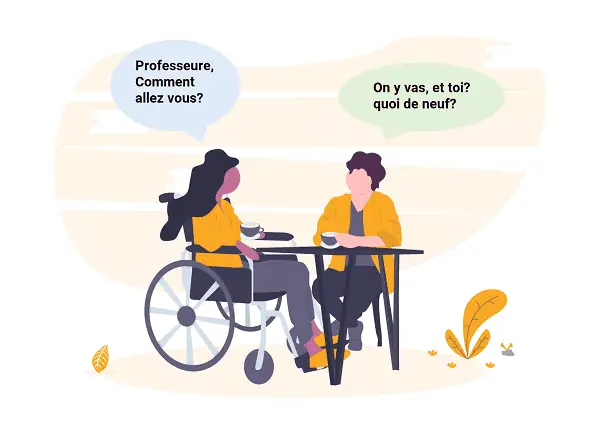
It’s common for a relationship to evolve from formal to informal, and with it, the appropriate pronoun shifts from “vous” to “tu”. This process is often called le dé-vouvoiement.
- Who initiates the change? Generally, the person of higher status, older age, or the one who initiated the conversation will offer to switch to “tu”. They might say something like:
- « On peut se tutoyer ? » (Can we use tu with each other?)
- « Tu peux me tutoyer. » (You can use tu with me.)
- When does it happen? This shift typically occurs after a period of acquaintance, when a level of comfort or personal connection has been established.
Cultural Importance
The “tu” and “vous” distinction is deeply embedded in French culture and reflects a nuanced understanding of social distance and respect. Using “vous” demonstrates respect for privacy, hierarchy, and personal space, while switching to “tu” signifies a bridge built, a friendship forged, or a comfortable familiarity.
Examples of sentences with Tu et Vous
- Tu es mon ami. – You are my friend. (informal, singular)
- Vous êtes mon professeur. – You are my teacher. (formal, singular)
- Tu aimes le chocolat. – You love chocolate. (informal, singular)
- Vous voulez boire quelque chose? – Do you want to drink something? (formal, singular OR plural)
- Tu viens avec moi ? – Are you coming with me? (informal, singular)
- Vous parlez français ? – Do you speak French? (formal, singular OR plural)
- Vous êtes très gentils. – You are very kind. (plural, always vous)
How to conjugate Tu and Vous in French
The most significant grammatical impact of choosing “tu” or “vous” is on verb conjugation.
a) Regular verbs (ending in -er)
- Verbs used with “tu” typically end in -es.
- Verbs used with “vous” typically end in -ez.
Examples:
- Tu étudies beaucoup. / Vous étudiez beaucoup.
- Tu parles français. / Vous parlez français.
- Tu chantes bien. / Vous chantez bien.
b) Verbs of the second group (ending in -ir)
- “Tu” verbs typically use the ending -is.
- “Vous” verbs typically use the ending -issez.
Examples:
- Tu finis. / Vous finissez.
- Tu choisis. / Vous choisissez.
c) Irregular verbs
Conjugations must be learned individually.
Examples:
- Tu es. / Vous êtes.
- Tu as. / Vous avez.
Common Questions about Tu and Vous
- Q: Can I use “tu” with a service person? A: Generally, no. Use “vous”.
- Q: What about young adults I don’t know? A: In formal settings, “vous” is safer.
- Q: Is it really rude to use the wrong one? A: It can be. It’s best to try to get it right.
- Q: If someone uses “tu” with me, should I use it back? A: Yes! It’s an invitation to use it back.
Dialogue
- Hi nephew, do you eat mangoes? I bought some. – Salut neveu, est-ce que tu manges des mangues ? J’en ai acheté.
- Yes aunt, and you? – Oui tante, et vous ?
- Mom, did you buy the watermelon for the fruit salad? – Maman, est-ce que vous avez acheté la pastèque pour la salade de fruits ?
- Yes son, and did you buy the soda? – Oui fils, et est-ce que tu as acheté le soda ?
Conclusion
Mastering the distinction between “tu” and “vous” is a significant step in your French learning journey. Observe how native speakers interact, and with practice, choosing the right “you” will become second nature!
Read next: