
French Subject Pronouns: A Complete Guide with Pronunciation, Examples & Exercises
Introduction: Why Pronouns Matter
Personal pronouns are the building blocks of communication in both English and French. Knowing them is necessary to progress from basic phrases to complex conversations.
You use subject pronouns constantly: when talking about yourself (I), talking to me (You), or referring to a group (They).
What is a Pronoun?
A pronoun is a word that replaces a noun (a person, animal, or thing) to avoid repetition. Subject pronouns specifically replace the subject.
- Antonio drinks juice. → He drinks juice.
- Among these books, I keep this one.
Note: There are many types of pronouns, but today we are focusing strictly on Subject Personal Pronouns.
French Subject Pronouns Chart
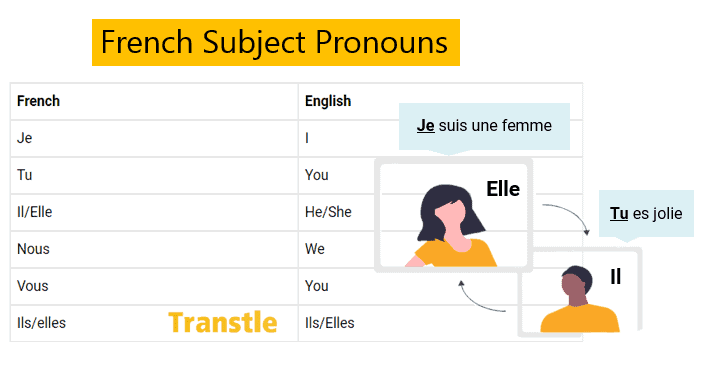
Use this chart to learn the French equivalents for English pronouns and how they represent the “grammatical persons” of a sentence.
| French | English | Grammatical Person |
|---|---|---|
| Je | I | 1st Person Singular |
| Tu | You (Informal) | 2nd Person Singular |
| Il / Elle | He / She | 3rd Person Singular |
| Nous | We | 1st Person Plural |
| Vous | You (Formal/Plural) | 2nd Person Plural |
| Ils / Elles | They | 3rd Person Plural |
Examples of Sentences
Here is how these pronouns appear in everyday French sentences:
- Je parle français — I speak French.
- Tu es belle — You are beautiful.
- Il est bon — He is good.
- Elle est petite — She is short.
- Nous voulons sortir — We want to go out.
- Vous êtes intelligents — You are smart.
- Ils sont forts — They are strong.
How to Use Pronouns in French
In French, pronouns usually go at the beginning of the sentence structure.
- They Go Before the Verb: The subject pronoun is placed before the verb.
Tu danses avec ton ami. (You dance with your friend.) - Almost Always Obligatory: Using the subject pronoun is required.
Elle mange du pain. (She eats bread.) - The “Je” Contraction (J’): “Je” becomes “J’” before a vowel or silent ‘h’.
J’aime les biscuits.
The “You” Dilemma: Tu vs. Vous
Choosing the right “you” depends on the number of people and the level of formality.
- Tu (Informal): For one person you know well.
- Vous (Formal/Plural): For more than one person, or when talking to a boss/stranger.
Impersonal and Special Uses
- Il pleut — It’s raining.
- Il faut — It is necessary (We/you have to).
- Il est — It is (telling time).
The Power of “On”
On is a highly versatile pronoun that can mean “we,” “someone,” or “you” depending on the context.
- “On” as “We”: En France, on mange des crêpes.
- “On” as “Someone”: On m’a dit que… (Someone told me…).
- “On” as “You” (General): On peut visiter Versailles.
In Short: Mastering French subject pronouns is your first step toward fluency. They are mandatory in every sentence, and understanding the nuances of Tu/Vous and On will make you sound like a natural speaker.