
How to Write an Essay: Step by Step Guide With Examples
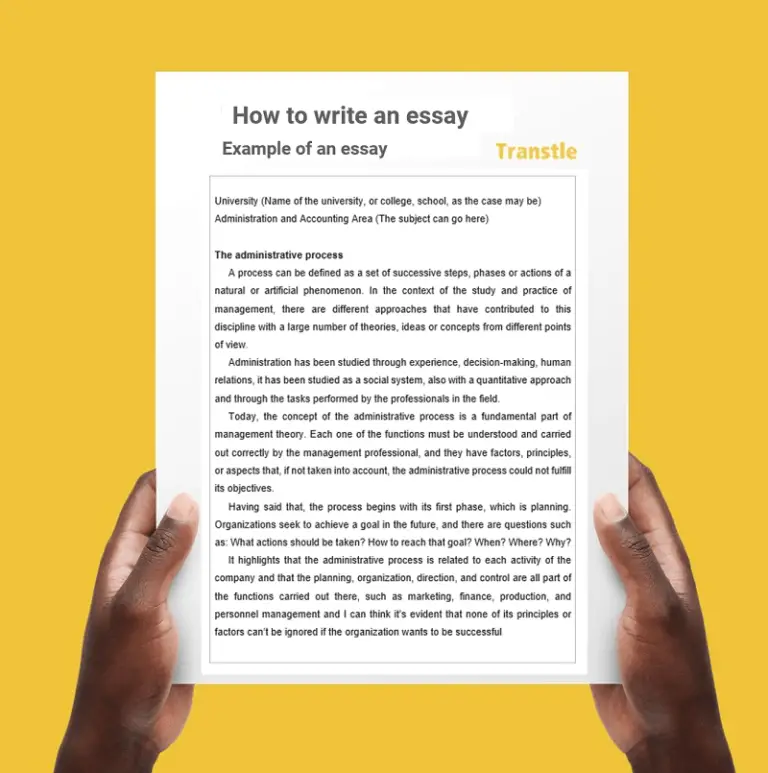
Writin an essay and doing it well requires understanding exactly what an essay is and mastering its rules of form and content. If you’ve ever stopped mid-paragraph wondering:
How many paragraphs does an essay have?
Does the essay have headings and a conclusion?
Are the introduction, body and conclusion on separate pages?
Are you still making your text “square”? Careful! The 7th edition of APA now requires left-alignment.
Looking for examples of essays as a guide? There are several at the end of this post!
In this guide, we are going to clear up all those doubts, including the latest updates from the APA Standards (7th edition), current as of 2026.
What is an essay?
An essay is a brief piece of writing that explains, analyzes, and interprets a specific topic. It serves as a synthesis of a subject where the author, in addition to presenting facts, expresses their personal opinion based on reliable information.
Unlike common informative texts, the essay allows for more creative freedom, and its sections are typically not separated by rigid internal headings.
Formatting and Presentation Rules (APA 7th Edition) – Updated
Visual appearance is essential to the academic validity of your work:
- Font: Fonts such as Arial 11, Times New Roman 12, or Calibri 11 are permitted.
- Line Spacing: The entire text must be double-spaced (2.0), with no extra spaces between paragraphs.
- Margins: There must be 2.54 cm (1 inch) on all sides (top, bottom, left, and right).
- Alignment (justification): Text must be left-aligned (ragged right margin). Do not justify the text. The only exceptions are the cover page and the main title, which are centered.
- Indentation: The first line of every paragraph must have a 0.5 inch (1.27 cm) indent.
- Paragraphs: A length of 3 to 10 lines is recommended to maintain clarity.
- Headings and Subheadings: In an essay, do not write the headings “Introduction,” “Body,” or “Conclusion.” The text should flow continuously, and using these specific titles should be avoided.
An essay does contain each of these sections, but unlike a monograph, they are not explicitly labeled; instead, the text is written as a cohesive whole. You can find an example of an essay at the end of this article.
Internal Structure: Parts of an Essay
A. The Introduction
Introduce the reader to the topic by following these logical steps:
- General Idea: Consists of presenting a broad or “macro” idea of the subject to be discussed. Example: If the essay is about soccer, start by defining what a sport is. Or, if the essay is about a specific type of personal pronoun, begin with the definition of what a pronoun is.
- Less General Idea: Narrow down the scope of the topic. Example: Mention that various sports exist and specifically define soccer.
- Contextualization (Actualización): The purpose is to place the essay in time and space—that is, the historical moment and/or geographical location of the context. Example: Discussing human rights violations occurring today in a specific region.
- An exemple: Provide specific cases related to the topic.
- Thesis Statement / Problem Statement: The fundamental idea that closes the introduction; it can be a problem, a background summary, or a central question, depending on the type of essay.
The most common essay, frequently assigned to students, is the “thesis statement” essay. This consists of developing the subject through explanations, comparisons, statements, and examples. It is in this statement where the fundamental idea of the essay is located, presented at the very end of the introduction.
B. The Body
This is the core of the essay and contains detailed information. Example: In an essay about soccer, this is where you would detail its history, rules, and championships.
- Organization: Each subtopic should be addressed in a separate paragraph.
- Use of connectors: It is recommended to start paragraphs with phrases such as: “Regarding…”, “In relation to…”, or “As for…”. Click here for List of connectors.
- Length: Since the body contains the fundamental and detailed information of the essay, it is usually longer than the introduction and the conclusion.
C. The Conclusion
The closing of the work, ideally consisting of a single paragraph similar in size to the introduction.
- Opening: Use a transition such as “To conclude…” or “In conclusion…”.
- Synthesis: Briefly revisit one or two key themes from the body.
- Emphatic Opinion: The author should be decisive with their judgment, using phrases like: “In my opinion,” “In my view,” “I believe,” “I maintain that…”, or “From my perspective…”.
In the final part, if it is a “topic-based” essay , the stance on the subject must be explicitly stated. Similarly, depending on the type of essay, the answer to the research question or the solution to the proposed problem should be presented.
References: How to Format References in an Essay
Not every source you consulted during your research should appear at the end of your paper. For your essay to be professional and compliant with regulations, follow these two golden rules:
-
Only What is Cited: In the reference list, do not include every text you read (such as magazines or websites that only served as inspiration). You must only include those sources that you explicitly mentioned within your essay through a citation.
-
Order and Format: References must always be organized in alphabetical order (by the author’s last name) and strictly follow the APA Standards format.
Remember: If you cited it in the body, it goes in the final list; if you didn’t cite it, don’t include it.
1. Books and Journals (Key Differences)
The Rules:
-
Books: This is the simplest structure. It only requires the Author, Year, Title (in italics), and Publisher.
-
Journals: Since they are part of a larger publication, you must include the article title (standard font), the journal name (in italics), the volume (in italics), the issue number in parentheses, and the page range.
Examples:
-
Book: García Márquez, G. (1967). Cien años de soledad. Editorial Sudamericana.
-
Journal: Pérez, J. (2022). The importance of the academic essay. Journal of Education, 15(2), 45-60.
2. Websites and Manuals (Basic Structure)
The Rules:
-
The Formula: Who created it? + When? + What is it called? + Where can I find it?
-
No Date: If the website has no clear date, always use (n.d.) (for “no date”).
-
Corporate Author: If there is no specific person, the author is the company or organization.
Examples:
-
Website: Transtle. (n.d.). How to write an essay with examples. Transtle: General Learning. https://www.transtle.com/es/aprendizaje-general/como-hacer-un-ensayo-con-ejemplos/
-
Manual: American Psychological Association. (2020). APA Style Quick Answers Guide: Seventh Edition. Pontificia Universidad Javeriana.
Important Note: Remember that in APA 7th edition, although the examples above are separated by type for explanation purposes, in your final essay they must all be mixed into a single, alphabetically ordered list.
Essay Examples
Example 1: Relaxation Techniques and Their Impact on Mental Health
(Introduction) Relaxation techniques have been practiced throughout history by various cultures as a means to achieve calm and well-being. In a modern world characterized by a fast pace and constant demands, stress and anxiety have become significant public health issues.
Understanding how relaxation techniques can positively influence our mental health is, therefore, crucial. A clear example of this awareness is the proliferation of mobile apps dedicated to meditation. This essay will explore the connection between these practices and mental health improvement today.
(Body) Relaxation techniques encompass a wide spectrum designed to reduce physical tension. Regarding stress reduction, deep breathing activates the parasympathetic nervous system. In relation to anxiety, mindfulness has proven effective in decreasing ruminative thoughts. Furthermore, regular practice fosters emotional resilience, allowing individuals to face challenges with a balanced perspective.
(Conclusion) In conclusion, relaxation techniques are a valuable tool for maintaining mental health. In my opinion, integrating these techniques into daily routines can strengthen an individual’s ability to cultivate inner peace. Therefore, I maintain that teaching these techniques should be an essential component of modern health approaches.
Full version HERE
Example 2: The Administrative Process
(Introduction) In a general sense, a process can be defined as a set of successive steps or phases. In management, various approaches have contributed theories from different perspectives. Today, the concept of the administrative process is a fundamental part of management theory that every professional must master.
(Body) The process begins with its first phase: planning. Organizations seek to achieve future goals by asking: What actions should be taken? How do we get there? Planning is thinking before acting. It takes into account external factors (economy, government) and internal factors (human and technological resources).
(Conclusion) To conclude, the administrative process relates to every activity of a company. I can evidence that none of its principles can be ignored if success is desired. I consider the process easy to adapt to all areas of life, as humans always have objectives and need efficiency to satisfy their needs.
To see the full essays click HERE
References
At Transtle, we ensure that our articles and content are reliable and of high quality by using trusted and verified sources to support our work. These sources may include bibliographic sources, academic research institutions, government data, and interviews with industry experts.
- Bolett, M. (2001). Lengua y Comunicación. Caracas: UNA.
- Madrid: Edit. Escuela Española. Alvarez L y R. Russotto. (1996). Cómo mejorar la redacción del ensayo escolar. Investigación y Postgrado
- Spa style
- Universidad Nacional Abierta. (2020). Lengua y Comunicación. Selección de Lecturas. Comp. Rada, N. Caracas