
Verb Être in French: Use, Conjugation, Examples, Exercises
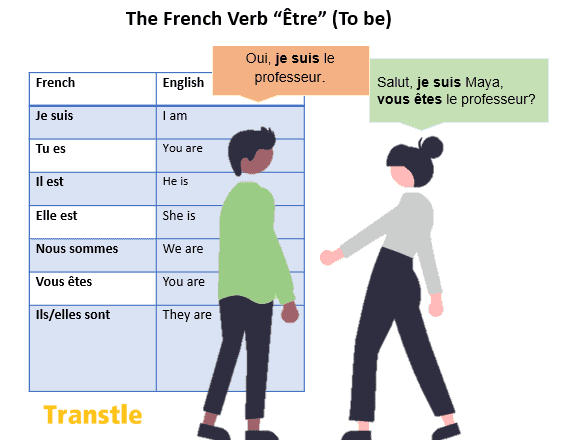
What is a verb
A verb is a word that expresses an action, an act, a movement, or a state. They refer to the activities done or experienced by people, animals, or things and their states of being.
Examples:
- Action: Karla eats eggs – Karla performs the action of eating. Verb: To eat.
- Movement: Camille runs to the beach – Camille is going or moving towards the beach. Verb: To run.
- Experienced: The baby is fed – The baby is experiencing the action of being fed. Verb: To feed.
The verb Être
The verb être means to be. It is used to express the characteristics, states, qualities, or location of people, animals or things, for example “Je suis une femme” – “I am a woman”, “il est en France” – “he is in France”. Learning this verb is necessary to be able to build complete and basic sentences in French.
This is a simple and complete guide that will help you understand quickly how this verb works.
Present Tense Conjugation (Le Présent)
The verb “être” is irregular, so you’ll need to memorize its forms. Here is the complete conjugation for the present tense.
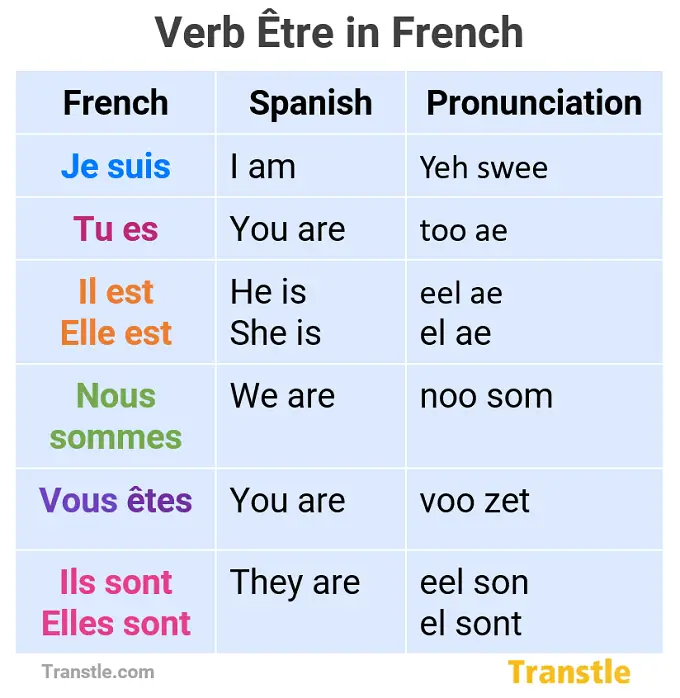
| Francés | Inglés |
|---|---|
| Je suis | I am |
| Tu es | You are (singular, informal) |
| Il/Elle/On est | He/She/One is |
| Nous sommes | We are |
| Vous êtes | You are (plural, or formal singular) |
| Ils/Elles sont | They are |
Examples of sentences with verb Être
- Tu es fort. – You are strong.
- Elle est jolie. – She is pretty.
- Vous êtes haut. – You are tall.
- Il est petite. – He is small.
- Nous sommes heureux. – We are happy.
- Vous êtes fous. – You are crazy.
- Ma soeur est a la France. – My sister is in France.
Main Uses of the Verb Être
The verb être has several important uses.
1. With attributive sentences
The verb être is used to express characteristics or qualities about someone or something or where it is located:
- Il est bien. – He is fine.
- Elle était en France. – She was in France.
- Le ciel est bleu. – The sky is blue.
2. As an auxiliary verb of movement
The verbs of movement express displacement from one place to another.
- Je suis venu. – I have come.
- Ils sont partis. – They have left / They are gone.
- Tu es arrivé. – You have arrived.
- Il est parti. – He has left / He is gone.
3. As an auxiliary verb of reflexive verbs
Reflexive verbs are verbs where the action ‘reflects back’ on the subject.
- Je me suis lavé les mains. – I washed my hands.
- Elle s’est coupé la main. – She cut her hand.
- Tu t’es habillé rapidement. – You got dressed quickly.
- Il/Elle s’est levé(e). – He/she got up.
Être in imperfect tense (l’imparfait)
The imparfait tense of être is used to describe actions or states that were ongoing, habitual, or descriptive in the past.
| French | English |
|---|---|
| J’ étais | I was |
| Tu étais | You were |
| Il / elle était | He/she was |
| Nous étions | We were |
| Vous étiez | You were |
| Ils / elles étaient | They were |
Examples:
- J’étais ici hier. – I was here yesterday.
- Vous étiez chez moi. – You were at my house.
- Il était heureux. – He was happy.
- Tu étais triste. – You were sad.
- Nous étions là. – We were there.
- Les chats étaient grands. – The cats were big.
Exercises
Test your knowledge of the verb “être” with these exercises.