
Days Of The Week In Spanish with examples and pronunciation
The days of the week in Spanish are basic words and are part of the vocabulary used every day. Knowing them is essential for getting by in the language. There are seven days of the week, and in Spanish they are: lunes, martes, miércoles, jueves, viernes, sábado, domingo.
In addition to learning the vocabulary, it is important to understand the grammatical rules associated with these days, such as the correct use of articles and prepositions.
See also: Months of the year in Spanish.
The Seven Days of the Week in Spanish
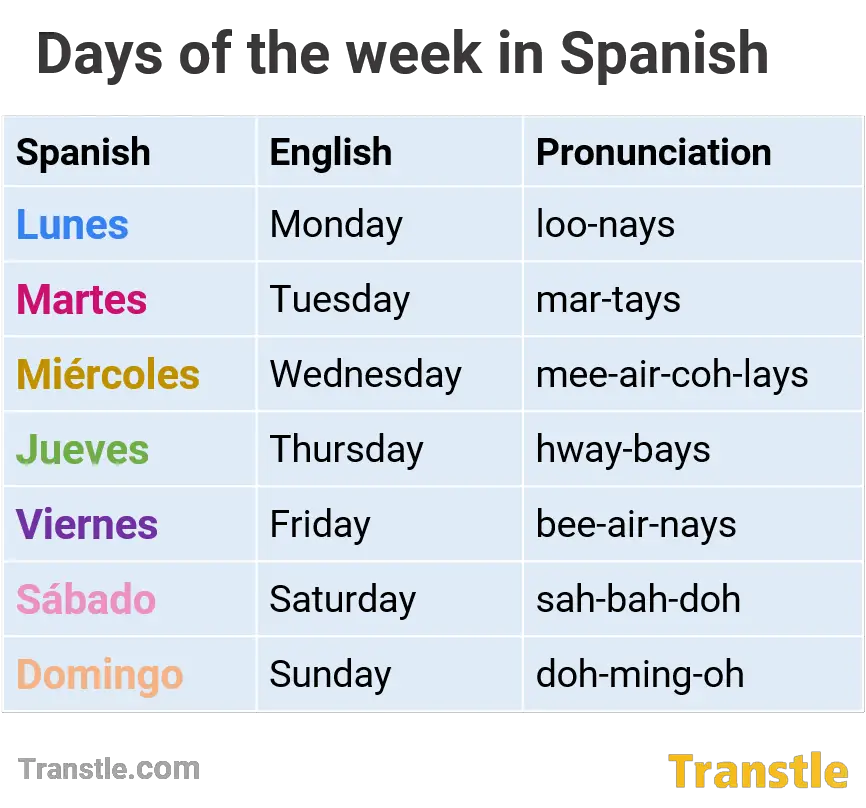
| Spanish | English | Pronunciation |
|---|---|---|
| Lunes | Monday | loo-nays |
| Martes | Tuesday | mar-tays |
| Miércoles | Wednesday | mee-air-coh-lays |
| Jueves | Thursday | hway-bays |
| Viernes | Friday | bee-air-nays |
| Sábado | Saturday | sah-bah-doh |
| Domingo | Sunday | doh-ming-oh |
Useful Related Vocabulary
| Spanish | English | Gender |
|---|---|---|
| Día | Day | (m) |
| Semana | Week | (f) |
| Días de la semana | Days of the week | (m) |
| Fecha | Date | (f) |
Key Grammar Rules for Days of the Week
1. Always write in lowercase: In Spanish, the days of the week are generally written using lowercase letters. Capitalization is only applied when the day is the very first word of a sentence. For more details, see this guide to capitalization in Spanish.
- •Mi día favorito es el sábado. (My favorite day is Saturday.)
- •Sábado de chicas. (Girls’ Saturday.)
Note how “sábado” remains lowercase within the sentence structure.
2. Expressing the current day: To express the current day, simply use the phrase “Es” (meaning “it’s” or “it is”) followed directly by the day of the week.
- •Es domingo. – It’s Sunday.
- •Es jueves. – It’s Thursday.
The verb “ser” (es) is used for defining the day.
3. Indicating events with “El”: When an event occurs on a specific day, it is mandatory to use the definite article “El”. Unlike English, the preposition “on” is not used. Learn more about definite articles here.
- •El viernes es mi cumpleaños. – My birthday is on Friday.
- •Voy a visitarte el martes. – I will go visit you on Tuesday.
- •El miércoles no hay clases. – There’s no school on Wednesday.
The article “el” is the direct equivalent of saying “on [day]”.
Common Time Expressions
| Spanish | English | Gender/Notes |
|---|---|---|
| Pasado mañana | The day after tomorrow | – |
| Antes de ayer | The day before yesterday | – |
| El día siguiente | The next day | – |
| El día anterior | The last day | – |
| El último día | The last day | – |
| Cumpleaños | Birthday | (m) |
| Día festivo | Public holiday | – |
| Mañana | Morning | – |
| Mediodía | Noon | (m) |
| Tarde | Afternoon | (f) |
| Noche | Night | (f) |
| Medianoche | Midnight | (f) |
Example Sentences Using the Days of the Week
- •Mi cumpleaños es el lunes. – My birthday is on Monday.
- •Es viernes y el cuerpo lo sabe. – It’s Friday and the body knows it.
- •Esta noche veremos estrellas. – Tonight we are seeing stars.
- •Es el último día de verano. – It’s the last day of summer.
- •Dime la fecha del día festivo. – Tell me the date of the public holiday.
- •Es mediodía, tengo hambre. – It’s noon, I’m hungry.
- •La escuela inicia el lunes 4 de octubre. – School starts on Monday, October 4th.
These examples integrate days and common time vocabulary for daily use.
Exercises
Now practice the days of the week with the following interactive exercises: