
Articles in Spanish: Guide, Grammar, Examples & Exercises

Spanish Articles: The, A, An, and Some
In this lesson, you will learn how to say the, a, an, and some in Spanish. Articles are essential words placed before a noun (person, animal, or thing) to provide context. While English articles are simple, Spanish articles are more descriptive because they indicate both the gender (masculine/feminine) and the quantity (singular/plural) of the noun.
1. Definite Articles: Saying “The”
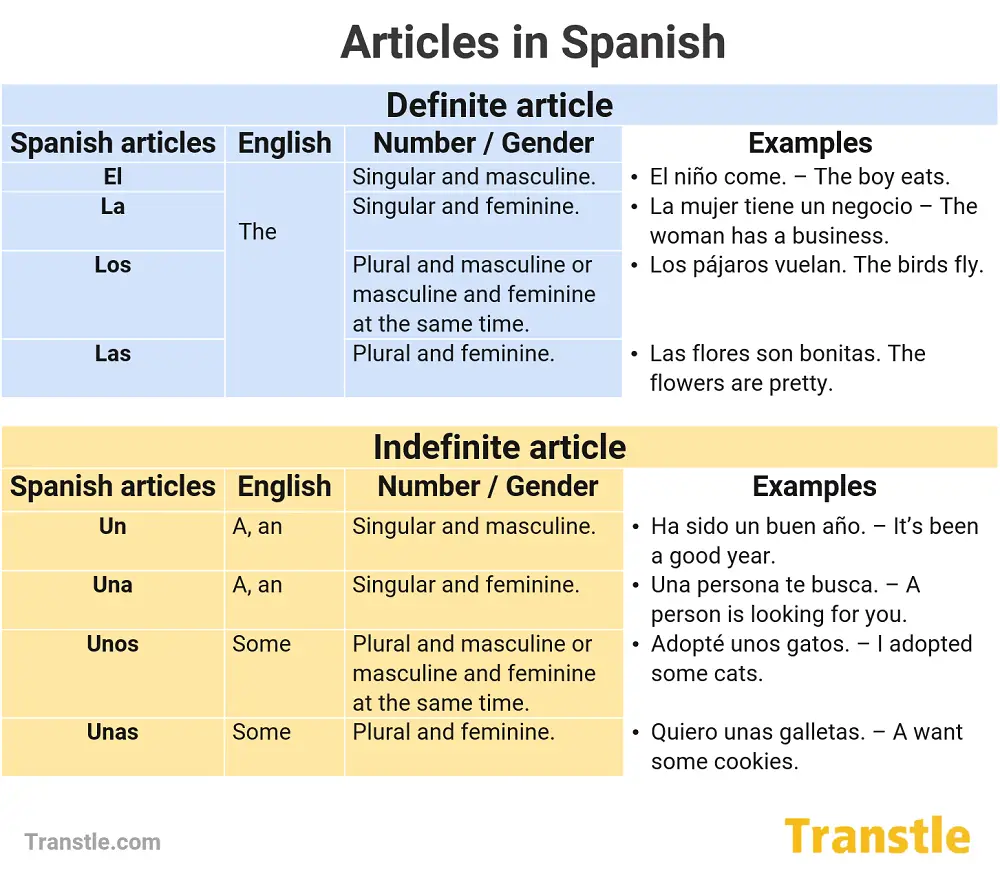
In English, there is only one: the. In Spanish, we use four versions depending on the noun:
| Spanish | English | Noun Category |
|---|---|---|
| El | The | Singular and masculine |
| La | The | Singular and feminine |
| Los | The | Plural and masculine (or mixed) |
| Las | The | Plural and feminine |
Examples and Sentences:
• El niño – The boy. (You must use el because niño is a masculine, singular noun).
• El cielo – The sky. (Cielo is a masculine singular noun).
• La niña – The girl. (Niña is a feminine singular noun).
• La flor amarilla – The yellow flower. (Flor is a singular feminine noun).
• Los niños – The boys. (Plural masculine noun).
• Los niños y niñas – The boys and girls. (Plural noun, referring to both male and females).
• Las flores amarillas – The yellow flowers. (Plural feminine noun).
• Las niñas – The girls. (Plural feminine noun).
Pro Tip: Remember that Spanish nouns have genders. To use the right article, you must learn if a word is masculine or feminine by heart.
2. Indefinite Articles: Saying “A, An, or Some”
These refer to non-specific items. Like definite articles, they must match the noun in gender and number.
| Spanish | English | Noun Category |
|---|---|---|
| Un | A, An | Singular and masculine |
| Una | A, An | Singular and feminine |
| Unos | Some | Plural and masculine (or mixed) |
| Unas | Some | Plural and feminine |
Examples of Indefinite Articles:
• Un pastel blanco – A white cake.
• Un gato – A cat.
• Una naranja – An orange.
• Una camisa – A shirt.
• Unos zapatos – Some shoes.
• Unos niños – Some children (including male and female).
• Unos estudiantes – Some students.
• Unas manzanas – Some apples.
• Unas vacaciones – Some vacations.
3. The Golden Rule: Agreement in Gender and Number
In Spanish, the article is like a mirror for the noun; it must reflect its gender and quantity.
• La pared azul (The blue wall): We use La because pared is a feminine and singular noun.
• Las paredes azules (The blue walls): We use Las because paredes is a plural feminine noun. Notice how the adjective azules also changes to match!
Summary Checklist
Articles are the “announcers” of the noun. To use them correctly, always identify:
- Gender: Is the noun masculine or feminine?
- Number: Is it one (singular) or many (plural)?
Summary
Exercises
Below, you will find a series of exercises designed to help you apply and reinforce your understanding of the rules for both definite and indefinite articles.