French Articles: Simple Guide, Use, Examples and Exercises
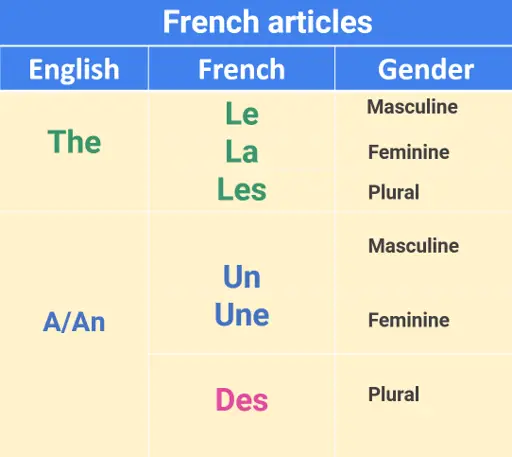
In French, articles are essential words that precede a noun, providing crucial information about it. They not only indicate the gender (masculine or feminine) and number (singular or plural) of the noun but also specify whether the noun refers to something definite (specific) or indefinite (non-specific).
Understanding French articles is fundamental, as they must always agree in gender and number with the noun they accompany. This necessitates learning the gender of each noun, a cornerstone of French grammar.
The Two Main Types of French Articles
French articles are primarily categorized into two types:
- Definite Articles: Used to refer to something specific, known, or already identified.
- Indefinite Articles: Used to refer to something non-specific, general, or previously unmentioned.
1. The French Definite Articles: Le, La, Les
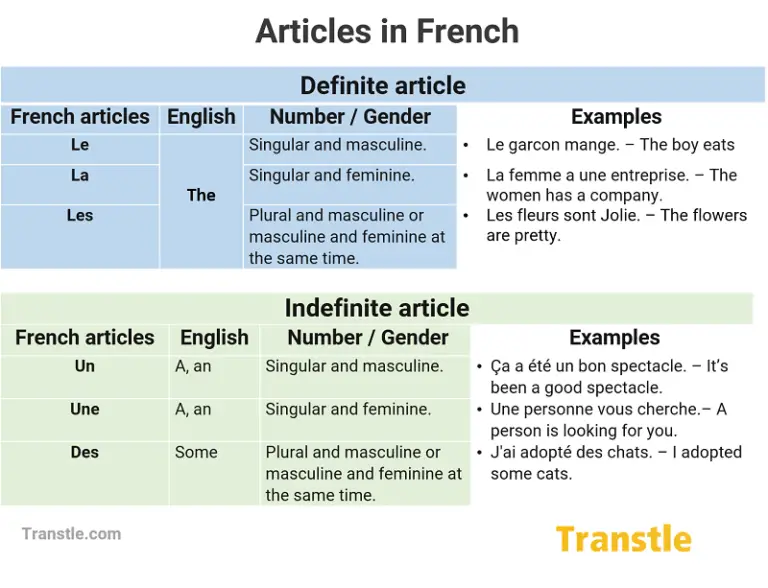
Definite articles in French correspond to “the” in English. They are employed when referring to a specific item or concept that is already known to the speaker and listener, or is generally understood.
| French Article | English Equivalent | Usage |
|---|---|---|
| le | the | Precedes a singular masculine noun. |
| la | the | Precedes a singular feminine noun. |
| les | the | Precedes plural nouns, whether masculine or feminine. |
Examples:
- Le garçon. – The boy. (Masculine singular noun)
- Le soleil. – The sun. (Masculine singular noun)
- La fille. – The girl. (Feminine singular noun)
- La maison verte. – The green house. (Feminine singular noun)
- Les filles. – The girls. (Feminine plural noun)
- Les garçons. – The boys. (Masculine plural noun)
- Les maisons vertes. – The green houses. (Feminine plural noun)
Contraction of Le and La: Using L’
When a singular definite article (le or la) is followed by a word that begins with a vowel (a, e, i, o, u) or a silent ‘h’, it contracts to l’. This contraction is crucial for fluent pronunciation and to avoid the awkward clash of vowel sounds (known as “hiatus” or “cacophony”).
Examples:
- L’hiver. – The winter. (Instead of Le hiver)
- L’orange. – The orange. (Instead of La orange)
- L’étudiant. – The student. (Instead of Le étudiant)
- L’hôpital. – The hospital. (Instead of Le hôpital)
2. The French Indefinite Articles: Un, Une, Des
Indefinite articles in French correspond to “a,” “an,” or “some” in English. They are utilized when referring to something non-specific, general, or an item that has not been previously introduced.
| French | English | Use |
|---|---|---|
| Un | A, an | Singular and masculine |
| Une | A, an | Singular and feminine |
| Des | Some | Plural, both masculine and feminine. |
Examples:
- Un gâteau blanc. – A white cake. (Masculine singular noun)
- Un chat. – A cat. (Masculine singular noun)
- Une pomme. – An apple. (Feminine singular noun)
- Des robes noires. – Some black dresses. (Feminine plural noun)
- Des chats. – Some cats. (Masculine plural noun)
Summary