
Avoir: How To Use it, Conjugation And Examples
The French verb “Avoir,” directly translating to “to have,” holds a pivotal position in the French language.
It is the second most frequently used verb, surpassed only by “être” (“to be”), and is indispensable for several grammatical functions.
Specifically, “Avoir” is employed to:
- Indicate ownership or possession (e.g., J’ai un chien – “I have a dog”).
- Express various states or feelings (e.g., J’ai faim – “I am hungry”).
- Form compound tenses, describing completed actions or events (e.g., J’ai mangé un gâteau – “I have eaten a cake”).
Understanding the conjugation and usage of “Avoir” is fundamental for constructing accurate and fluent French sentences.
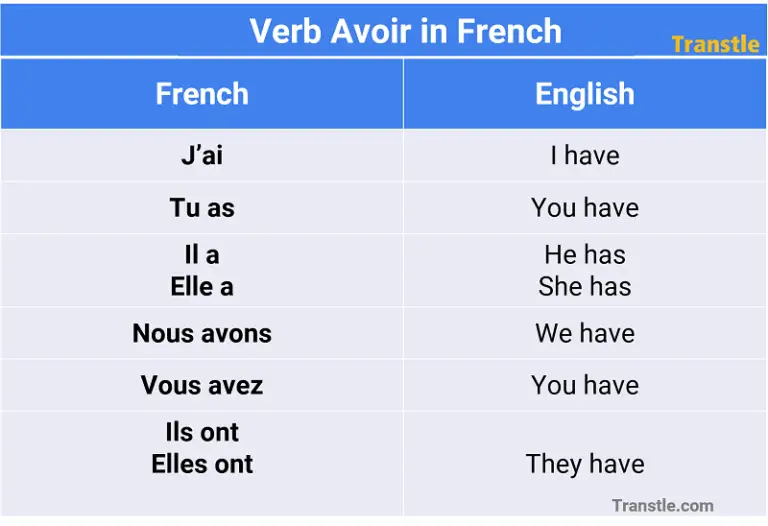
Conjugating “Avoir”: Present Tense (Le Présent Simple)
This is how “to have” looks in the present moment.
| French | English |
|---|---|
| J’ai (Je ai) | I have |
| Tu as | You have |
| Il / Elle a | He / She / It has |
| Nous avons | We have |
| Ils / Elles ont | They have |
Important Contraction: Notice that “Je ai” becomes “J’ai.”
This contraction (shortening two words by removing a vowel) is very common in French, especially with “Je” before a vowel sound, to make pronunciation smoother.
Examples in the Present Tense:
- J’ai une voiture. – I have a car.
- Elle a un beau sourire. – She has a beautiful smile.
- Vous avez de belles plantes. – You have beautiful plants.
- Ils ont vu le film. – They have seen the film.
- Tu as mangé une pomme. – You have eaten an apple.
How to Use “Avoir” in French: Two Main Roles
The verb Avoir is a fundamental verb in French, both for its own meaning and for its vital role in forming other verb tenses.
It performs two main functions:
1. As a Main Verb (Indicating Possession or State):
To show possession or ownership:
- J’ai un livre. – I have a book.
- Le jardin a une piscine. – The garden has a pool.
- Le chien a une balle. – The dog has a ball.
- La fille a les yeux noirs. – The girl has black eyes.
- Ils ont un problème. – They have a problem.
- Nous avons une petite maison. – We have a small house.
- Ils ont des chemises rouges. – They have red shirts.
To express feelings or states (often translated with “to be” in English):
- J’ai faim. – I am hungry. (Literally: I have hunger)
- Tu as froid. – You are cold.
- J’ai peur. – I am scared.
- Elles ont soif. – They are thirsty.
2. As an Auxiliary Verb (Forming Compound Tenses):
Avoir is a crucial auxiliary verb used to form most compound tenses in French, like the Passé Composé.
Its main function is to “help” the main verb describe actions or events that have already occurred.
The general structure for forming compound tenses with Avoir is: Subject + Auxiliary Verb (Avoir) + Main Verb’s Past Participle + Complement
- J’ai mangé un gâteau. – I have eaten a cake.
- Il a coupé la viande. – He has cut the meat.
- Tu as mangé une pomme. – You have eaten an apple.
- Ils ont vu le film. – They have seen the film.
Conjugating “Avoir”: Imperfect Tense (L’Imparfait)
The imparfait tense of Avoir is used to describe past actions or states that were ongoing, habitual, or descriptive.
Think of it as “used to have” or “was having” in the past.
| French | English |
|---|---|
| J’ avais (Je avais) | I had |
| Tu avais | You had |
| Il / elle / avait | He/ She had |
| Nous avions | We had |
| Vous aviez | You had |
| Ils / elles avaient | They had |
Examples with Avoir in the Imperfect Tense:
- Vous aviez un magasin. – You had a store (in the past).
- Il avait une copine. – He had a girlfriend (at that time in the past).
- J’avais un ami au Venezuela. – I had a friend in Venezuela (back then).
Exercises
Now practice the verb avoir with the following test or exercises.